
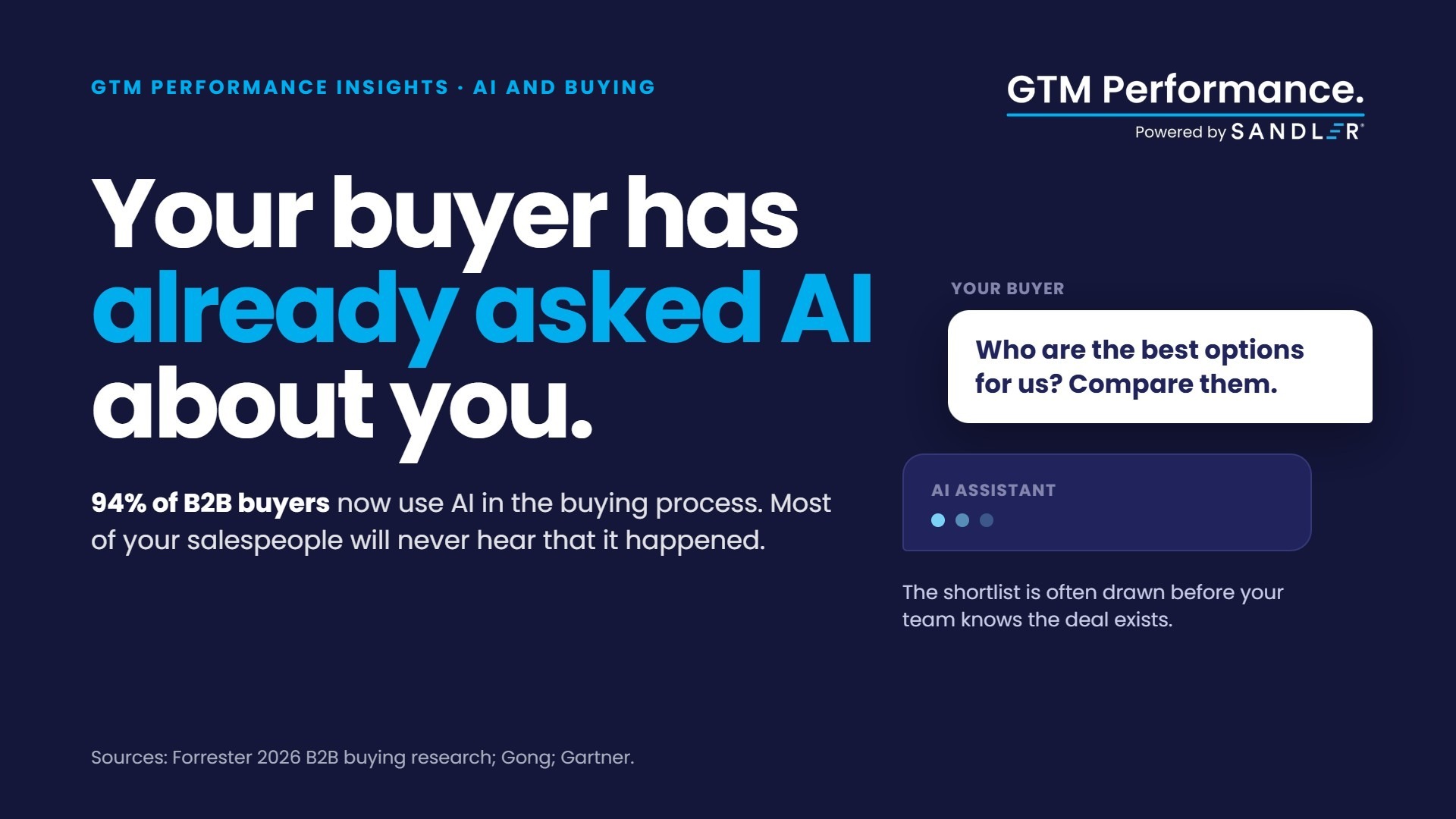
Your buyer has probably already asked AI about your business, and your salesperson almost certainly doesn't know it happened.
Forrester's 2026 research puts AI use in the B2B buying process at 94%, up from 89% a year earlier. Gong's conversation data shows that the number of buyers telling sales teams they found them through AI, or are using it to evaluate them, has more than tripled since early 2024. Gong treats its own figure as the floor, because it only counts the buyers who mention it, and most don't.
Gartner adds a twist. 69% of buyers still want a salesperson to check what AI has told them, yet almost as many expect misleading information from a sales rep (49%) as from an AI tool (51%). So the buyer arrives with a shortlist and a view already formed, wants a person to test it, and isn't convinced the person is any more reliable than the tool.
In October I hosted the CRO sessions at the ECI Partners Unlocked Growth Summit at the St Pancras Renaissance Hotel, with sales leaders and chief executives from across the ECI portfolio. Many of those chief executives could have spent the afternoon anywhere in the programme and chose the sales sessions, which tells you how far up the agenda the effect of AI on selling now sits. Four points came out of the day.
The shortlist is often drawn before you know the deal exists
Three in four people in the room had seen RFPs that were clearly written by AI, and more and more often an AI is doing the marking as well. James Wilde of Croud showed the room, live, how one brand appears across ChatGPT, Gemini, Claude and Copilot, and which sources each model draws on. If your business doesn't show up well when a buyer, or the buyer's AI, goes looking, you may never be invited to pitch.
Most teams are using AI to do more of the same
In the 2026 GTM Benchmark from Fullcast and Pavilion, businesses that used AI to improve deal quality grew revenue per seller by 61%. Those that used it to drive volume saw revenue per seller fall by 26%. Sending more emails and booking more calls from the same playbook is the easy way to use AI, and the data says it is the wrong one.
The tools that make teams better are the least used
Nobody in the room was using AI roleplay or practice consistently. The biggest blocker people named was managers lacking the time, or the skills, to coach from what the tools produce. A salesperson who has rehearsed a difficult conversation and been coached on the result walks into a meeting with an informed buyer far better prepared than one who is meeting the objection for the first time.
Where AI sits in sales comes down to accountability
The debate about who owns AI in the go-to-market team misses the point. If you are accountable for sales performance, you are accountable for how AI is used in the processes that deliver it, and when more than one person is accountable, no one is.
What changes once the buyer engages
When the buyer has done this much of the work before the first call, the salesperson's job moves from presenting information to testing it. That means preparing for what the buyer will already believe, asking the questions that show whether the AI's picture of their problem is right, and being the more reliable source in the room. For sales leaders it means looking again at the process and playbooks the team uses, and at what an A-player salesperson looks like now.
If you want to know where your sales team stands on this against the best, or how it could sell more effectively within 90 days, talk to us.